
Criminal Court Cases in Delaware County
Delaware County is Pennsylvania's 32nd Judicial District. Adult criminal matters generally start before a Magisterial District Judge, often called an MDJ. That court handles the complaint, preliminary arraignment, bail, and preliminary hearing. If the Commonwealth shows enough evidence for the case to continue, the MDJ holds it for the Delaware County Court of Common Pleas in Media. Summary and traffic matters may remain at the lower level. This division matters because one incident can have an MDJ docket and a later Common Pleas docket.
The Office of Judicial Support maintains modern Common Pleas filings. Its criminal-record and archive contact is 610-891-4370. Source documents that are not attached to the public docket may be requested there at the Government Center, 201 West Front Street, Media, Pennsylvania 19063. An MDJ file stays with the district court that received it, so use the county's court list to identify that office.
Choose the Delaware County Criminal Court
The county Public Defender identifies 26 Magisterial District Courts. Their boundaries follow municipalities, wards, and precincts, which makes the incident location more useful than the defendant's current mailing address. The official Delaware County district-court list provides each court's jurisdiction, address, and telephone number.
If several courts serve one municipality, compare the ward or precinct with the jurisdiction list. Then select the matching district number in UJS Case Search. Call the listed court when an entry is too new to appear or the location boundary is unclear. The official list is also shown in this county image. It demonstrates why a local court number is a key search field, not a minor detail.
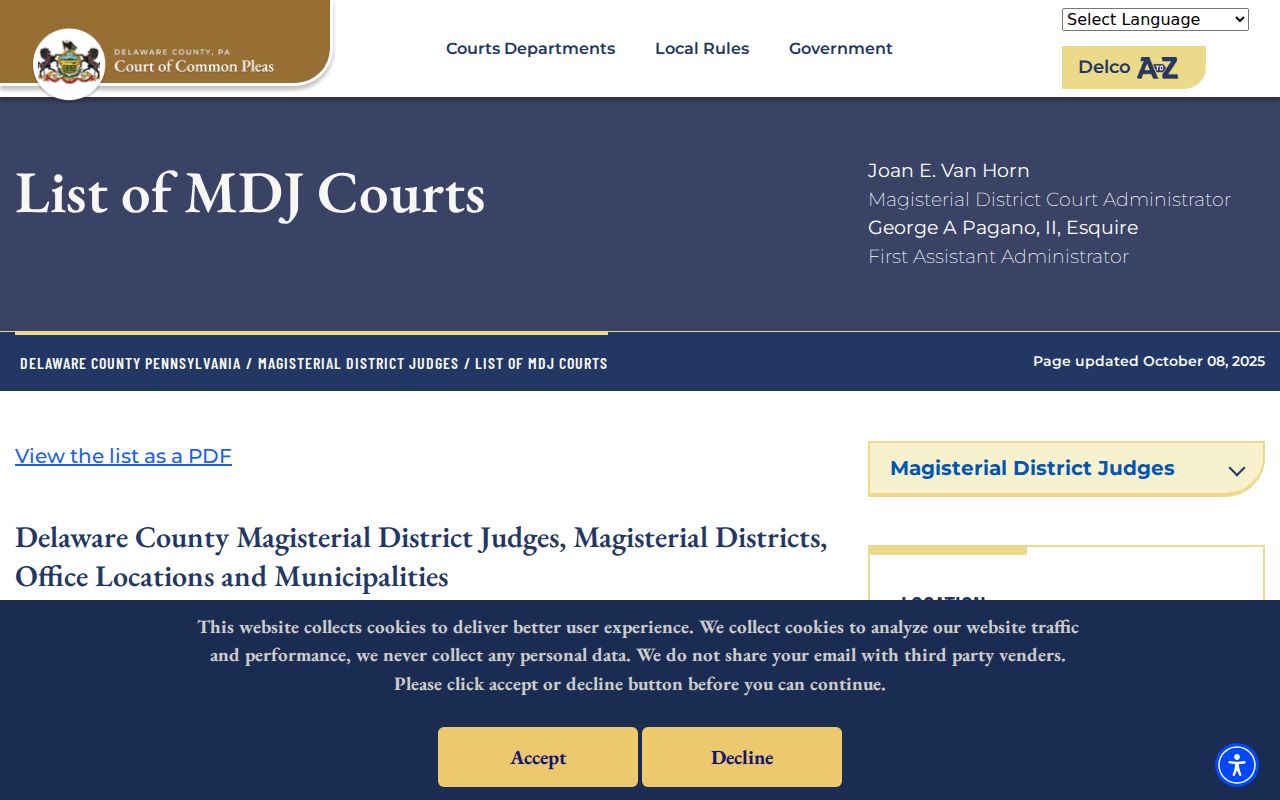
Once the right MDJ docket is found, its cross-court history can point to the Common Pleas case if the charge was held for court.
Delaware County Case Record Searches
The free Unified Judicial System Case Search covers public MDJ and Common Pleas dockets. It also provides public calendars. Recent filing-office entries may take time to reach the online system, and protected matters do not appear. A careful search uses more than one identifier when possible.
- Open Case Search and choose the Magisterial District or Common Pleas court tier.
- Select Delaware County, then search by participant, docket, OTN, organization, SID, or police complaint number.
- Compare the filing date, court number, charges, and identifiers before treating a result as a match.
- Open the docket sheet and review events, dispositions, sentence details, and cross-court links.
- Contact the filing MDJ or Office of Judicial Support for source documents or a record that is not online.
| Search route | Best use | Key detail |
|---|---|---|
| Participant | Name search | Use available identity details to avoid a false match |
| Docket number | Known case | Select the correct court tier and county |
| OTN | Track a charge | Links the offense-tracking trail across records |
| Police incident or complaint | Known agency number | Useful when a name has variants |
| SID or organization | Exact identifier or entity | Available only when the value is known |
The statewide interface shown below lets users choose an identifier and court level. That structure supports both an early MDJ check and a later Delaware County Common Pleas search.
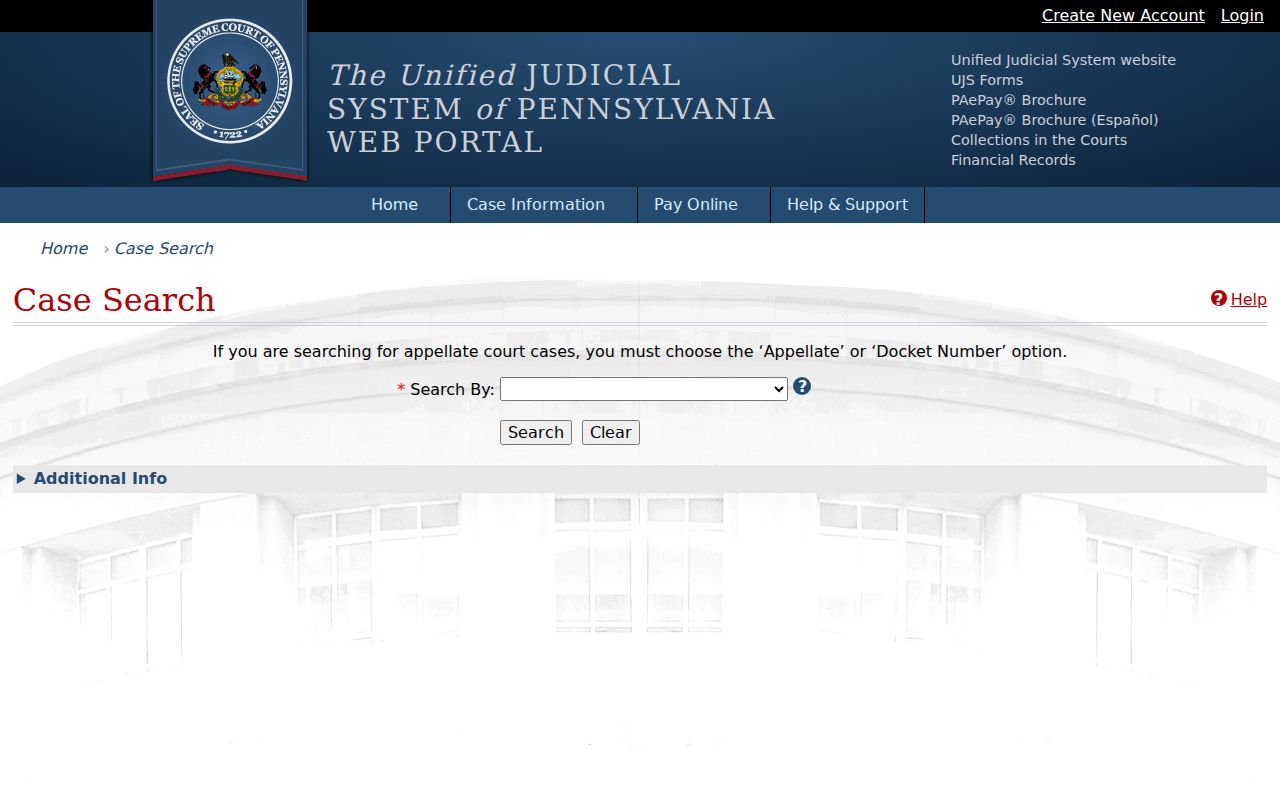
PAeDocket is the free mobile companion and searches the same major identifier types when a phone is more convenient.
Read Delaware County Criminal Bail Entries
Bail answers whether and under what conditions a person may remain out of custody while the case proceeds. It does not decide guilt. A docket can show bail type, amount, status, and related events, while the county Bail Agency handles interviews and bail functions. The agency is in the Courthouse Basement at 201 West Front Street and can be reached at 610-891-4353 during county business hours.
Bail payments and refunds follow a separate path through the Office of Judicial Support first-floor counter at 610-891-5693 or PAePay Bail. The Delaware County Pre-Trial and Bail page connects readers to the criminal docket, jail, and payment routes.
The county page pictured here makes those divisions visible. It helps prevent a common mistake: calling the jail for a court-file copy or asking Judicial Support to explain a custody decision.
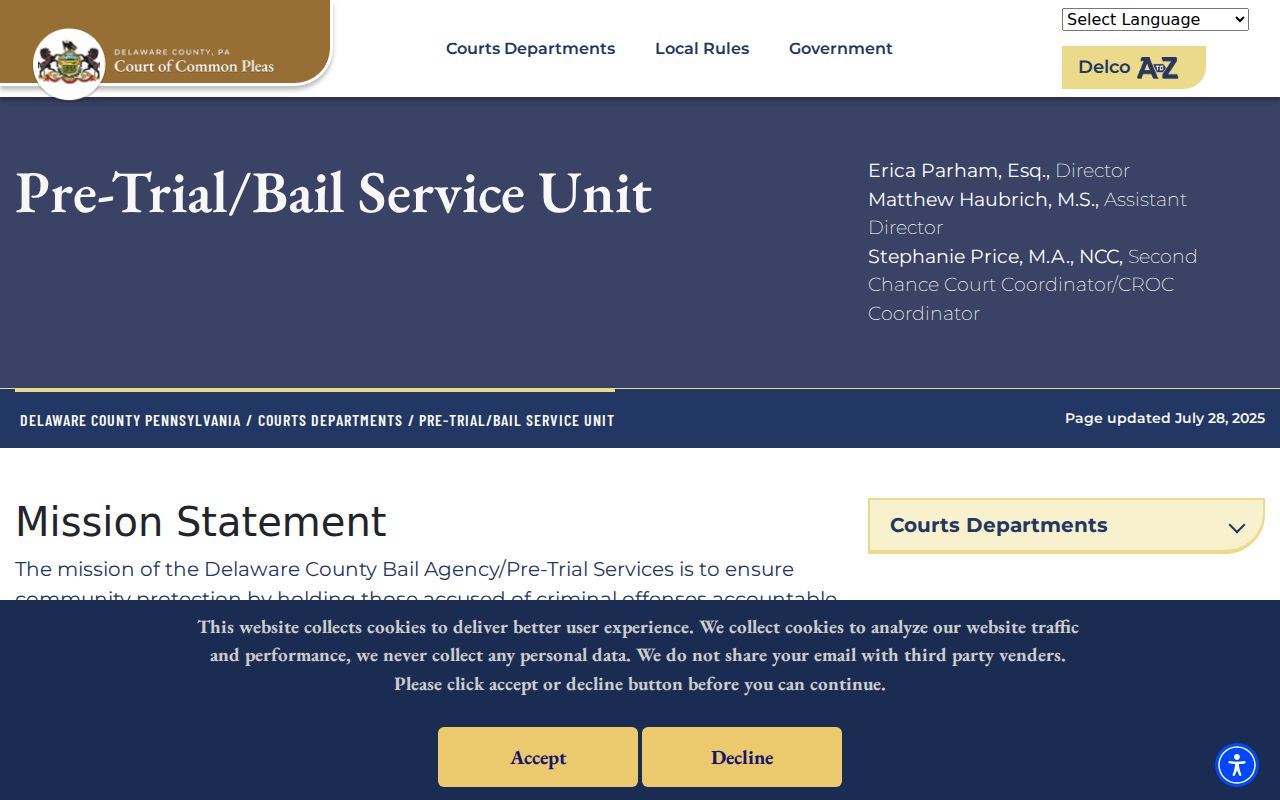
Use the docket for the filed bail order and the named county office for the transaction or service that follows from it.
What a Criminal Case File Contains
A public UJS docket is a structured report about the case. It is not always a scan of every filed paper. The Office of Judicial Support may hold the complaint, orders, motions, or other source documents that a reader needs. The docket remains the best index because it identifies the court, filing sequence, and outcome.
| Case identity | Docket number, county, court, filing date, status, OTN, and police complaint number. |
|---|---|
| Participants | Public defendant display, counsel, and other permitted case roles. |
| Charges | Offense, statute, grade, count, and arrest or filing details. |
| Bail and calendar | Bail type, amount and status, hearing dates, courtroom, and judicial officer. |
| Docket events | A dated sequence of filings, hearings, orders, and court action. |
| Outcome | Offense-by-offense disposition, sentence, costs, fines, restitution, and payment status. |
A disposition is the recorded result for a charge, such as dismissal, withdrawal, plea, or verdict. Read it by count. Charges can change between the complaint and final judgment, so an early allegation should not be reported as the final result.
Track Delaware County Charges by OTN
The Offense Tracking Number, or OTN, is especially useful when a case moves between court levels. It connects the charge trail created after an arrest with the court record. A name may be spelled in more than one way, and a person can have several unrelated dockets. The OTN narrows that uncertainty.
Start at the MDJ docket when the matter is recent. Check the complaint identifiers, bail, and preliminary-hearing result. If it says the charge was held for court, follow the cross-court history or search the OTN at Common Pleas. A dismissal or withdrawal at the MDJ level means the same count should not be assumed to continue.
When the identifiers disagree, contact the filing court. UJS directs correction questions to the office that entered the data. Compare the court docket with the arresting agency record and a personal Pennsylvania State Police Access and Review if the concern involves one's own repository record.
Criminal Case Stages in Delaware County
Each stage creates a different entry. The complaint states the filed accusations. Preliminary arraignment gives notice, addresses counsel and bail, and sets the next date. At the preliminary hearing, the MDJ decides whether the prosecution has shown a prima facie case, meaning enough evidence for the charge to continue. It is not a trial verdict.
Case flow: Charges Filed › Arraignment › Pretrial › Plea or Trial › Disposition › Sentencing
After a hold for court, Delaware County Common Pleas records the formal case activity. Pretrial motions, negotiated pleas, trial events, and offense-level dispositions appear in sequence. Sentencing comes after a conviction or plea and can include confinement, supervision, financial obligations, or other terms. Always read the latest docket entries because a pending count may later be amended, withdrawn, or resolved.
Delaware County Criminal Archives Before 1930
Modern case search does not reach the full history of Delaware County courts. The county Archives holds criminal docket books from 1806 through 1929 and criminal case papers from 1790 through 1922, including name indexes. These records can support genealogy, local history, and research into older court practice.
The Delaware County Archives page explains that later criminal files go to Judicial Support. That handoff gives researchers a clear date-based route instead of relying on a modern UJS search for material it was not built to contain.
The Archives interface pictured below marks this historical records layer. A useful request includes the person's name, an approximate year, and any known docket reference.
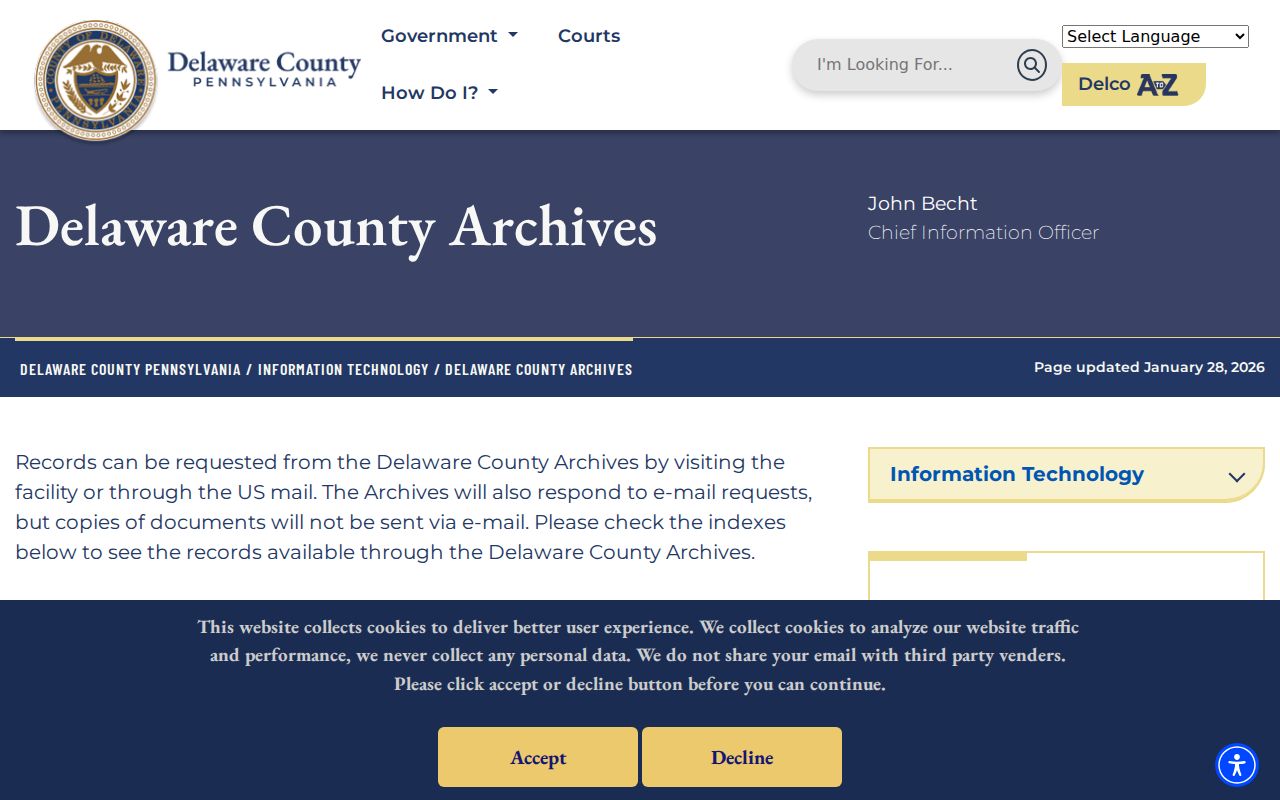
For post-1950 criminal files, the county expressly routes the inquiry to Office of Judicial Support rather than the Archives.
Access Rules for Case Records
Judicial records follow Pennsylvania's Unified Judicial System public-access policy and court rules, not the county's ordinary Right-to-Know Law request route. Public Case Search excludes juvenile, sealed, expunged, pending-expungement, limited-access, and destroyed matters. Protected identifiers are removed from public reports. Secure docket access is credentialed and can reveal more content only to authorized users.
A missing result is therefore not a universal certificate that no case exists. It may reflect a spelling or court-level error, a delay in data entry, or a lawful restriction. Try the MDJ and Common Pleas tiers, use another known identifier, and contact the filing office. For a broader explanation of how county files and state repository records differ, see the Delaware County criminal history overview.
Police investigative records are a different category. Request the court docket from the court and the police report from the investigating agency. Law-enforcement audio or video uses Pennsylvania's Act 22 process. Sending every request to county open records is likely to delay the answer.
Public and Secure Delaware County Dockets
The public docket offers enough structure to trace charges, dates, bail, court events, counsel, dispositions, sentences, and financial entries. It may allow a docket PDF to be viewed, saved, or printed. It does not promise downloadable copies of every motion, affidavit, order, or exhibit.
Secure access is for credentialed users with a role recognized by the judicial system. Its existence does not create a right for a member of the public to see restricted data. When a public docket points to a document but does not supply it, ask the filing court what access or copy process applies. This keeps the request tied to the office that holds the source file.
That distinction also explains why the UJS result and a standard PATCH certificate can differ. UJS reports the public court docket. PATCH reports the Pennsylvania State Police Central Repository response under criminal-history dissemination rules. Neither should be treated as a copy of the other.